
Digital Marketing: Complete Guide to Content Strategy, SEO and Content Quality
Explore a complete digital marketing strategy covering content planning, topical authority, original research, content freshness, content audits, E-E-A-T and editorial standards.
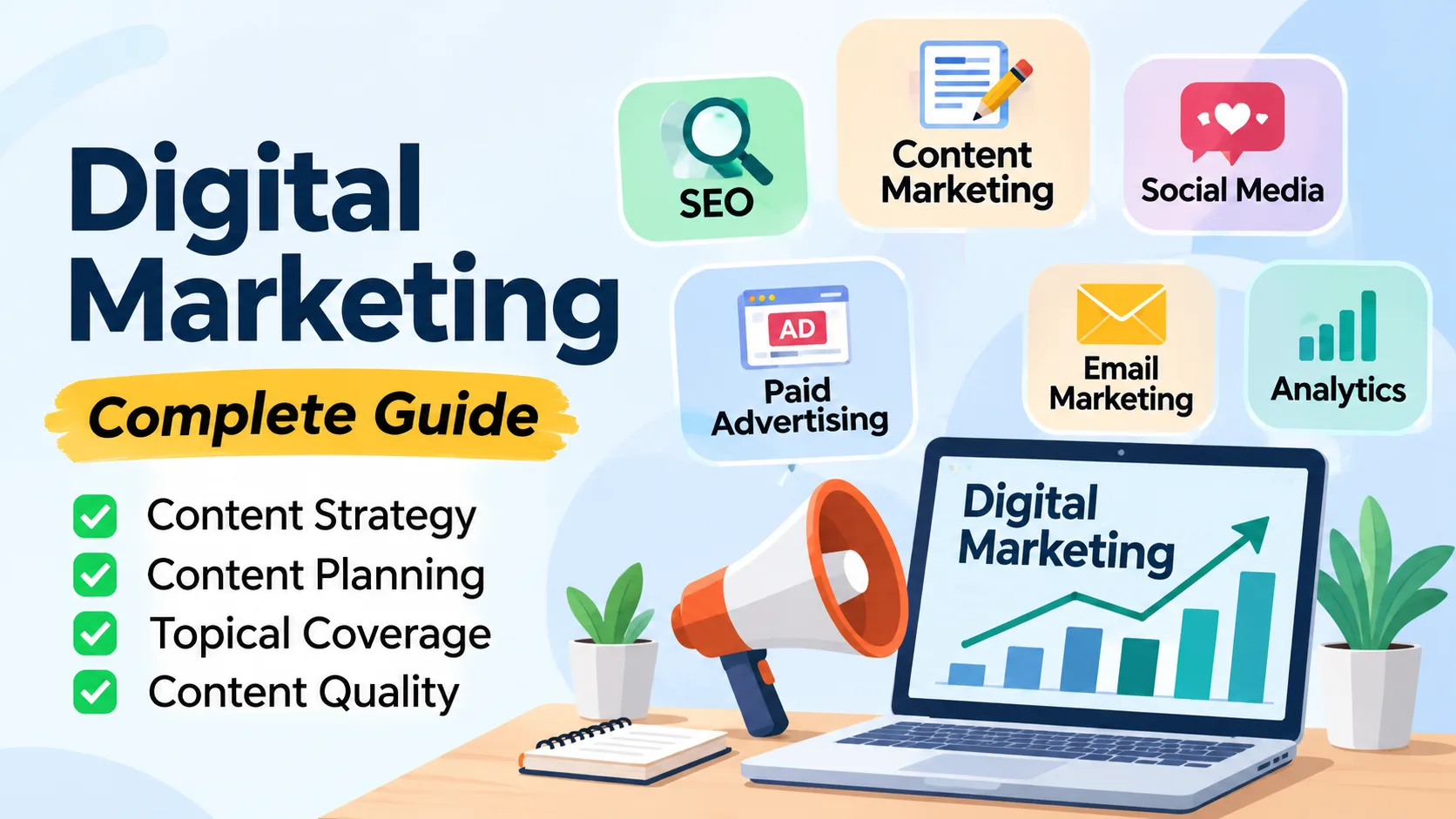
Digital Marketing: Complete Guide to Content Strategy, SEO and Content Quality
Digital marketing has become an essential part of how businesses attract customers, build brand awareness and generate revenue online. However, succeeding in digital marketing requires more than publishing blog posts, creating social media accounts or running advertisements. Businesses need a well-defined strategy that connects their audience's needs with useful information, relevant services and measurable business objectives.
One of the most important elements of successful digital marketing is content. Websites that consistently publish relevant, informative and trustworthy content can build stronger relationships with their audiences and create opportunities to attract organic search traffic.
However, publishing more articles does not automatically produce better results. A website may contain hundreds of blog posts but still struggle to attract visitors because its content is repetitive, poorly planned, outdated or unrelated to what people actually search for.
This is where content strategy, content planning, topical coverage and editorial quality become important.
A successful digital marketing approach focuses on creating valuable resources, maintaining existing content, understanding search intent and continuously improving website performance.
This guide explains how businesses can build an effective digital marketing content strategy, improve topical coverage, conduct original research, identify content decay, manage content cannibalization and establish editorial standards that support long-term growth.
What Is Digital Marketing?
Digital marketing is the process of promoting products, services and brands through online channels and digital technologies.
Businesses use digital marketing to reach potential customers, communicate their value and encourage actions such as website visits, enquiries, registrations and purchases.
Common digital marketing channels include:
-
Search engine optimisation (SEO)
-
Content marketing
-
Social media marketing
-
Email marketing
-
Pay-per-click advertising
-
Affiliate marketing
-
Video marketing
-
Influencer marketing
-
Local SEO
-
Online reputation management
Each channel serves a different purpose, but they can work together as part of a broader marketing strategy.
For example, a company offering website development services might use SEO to attract people searching for website designers, publish educational articles to explain website costs, run Google Ads to reach customers with immediate requirements and use email marketing to follow up with potential clients.
The objective is not simply to generate online visibility. It is to attract the right audience and help that audience make informed decisions.
Why Is Content Important in Digital Marketing?
Content provides the information people need when researching a problem, comparing solutions or deciding whether to purchase a service.
A business website can use content to explain its services, answer customer questions, demonstrate industry knowledge and establish credibility.
Consider a customer searching for digital marketing services.
Before contacting an agency, the customer might want to understand:
-
What digital marketing includes.
-
How SEO helps businesses.
-
How much digital marketing services cost.
-
Whether social media advertising is useful.
-
How long SEO takes to produce results.
-
How to evaluate an agency.
-
Which marketing strategy is suitable for a small business.
A website that answers these questions with practical and accurate information can help the visitor understand the subject and evaluate available options.
Content also supports other marketing activities. Blog articles can support service pages through internal links, email campaigns can distribute useful resources, and social media posts can introduce audiences to detailed website guides.
A strong content strategy therefore considers how individual pages work together instead of treating every blog post as an independent publication.
1. Content Strategy: Build a Clear Direction Before Publishing
Content strategy is the process of deciding what information a business should create, who it should serve, how it should be distributed and what results it should achieve.
Without a clear strategy, businesses often publish articles based on random keyword suggestions or trending topics.
This creates several problems:
-
Multiple articles may cover the same subject.
-
Important topics may remain unexplained.
-
Content may attract visitors who are not potential customers.
-
Existing articles may become outdated.
-
Publishing resources may be wasted on low-value subjects.
A documented content strategy helps avoid these problems.
Define Your Target Audience
Start by identifying the people who are most likely to use your website, product or service.
Understand their requirements, problems, knowledge level and decision-making process.
For example, a digital marketing agency may target three audience groups:
Small business owners: They need affordable ways to generate enquiries, improve local visibility and attract customers.
Marketing professionals: They need advanced information about campaign optimisation, analytics, SEO and marketing automation.
New entrepreneurs: They need beginner-friendly explanations about digital channels, marketing costs, website development and customer acquisition.
These audiences have different information requirements. A single generic article may not satisfy all of them.
Connect Content With Business Objectives
Every content topic should have a purpose.
Common objectives include:
-
Increasing relevant organic traffic.
-
Generating qualified leads.
-
Improving brand awareness.
-
Supporting important service pages.
-
Educating potential customers.
-
Building industry credibility.
-
Improving customer retention.
For example, an article explaining the benefits of local SEO can attract small business owners, while a detailed guide about local SEO pricing can help visitors evaluate whether to purchase a service.
Both articles may support the same business, but they serve different stages of the customer journey.
Understand Search Intent
Search intent describes what someone is trying to accomplish when entering a query into a search engine.
The main types include:
Informational intent: The user wants to learn something.
Example: What is digital marketing?
Navigational intent: The user wants to find a particular website or brand.
Example: Google Ads login.
Commercial investigation: The user is comparing products or services.
Example: Best digital marketing agencies for small businesses.
Transactional intent: The user is ready to take an action.
Example: Hire a digital marketing agency.
Understanding intent helps determine the appropriate content format.
A beginner's educational guide should not be written like a sales landing page. Similarly, a service page should not be filled with unrelated educational information when the visitor wants to enquire about a service.
2. Content Planning: Turn Your Strategy Into an Actionable Plan
Content planning converts strategic goals into a structured publishing process.
A content calendar helps businesses organise article ideas, keywords, publishing dates, authors, research requirements and internal links.
Before creating an article, prepare a content brief.
A useful content brief includes:
| Element | Description |
|---|---|
| Main topic | Primary subject of the article |
| Focus keyword | Main search phrase |
| Search intent | Purpose behind the search |
| Secondary keywords | Relevant related phrases |
| Target audience | Intended readers |
| Content format | Guide, tutorial, comparison or case study |
| Outline | Main headings and supporting sections |
| Research | Sources, examples and supporting evidence |
| Internal links | Related pages on the website |
| Author | Responsible content creator |
| Review date | Planned content evaluation date |
Create a Practical Content Calendar
A content calendar should prioritise important topics rather than simply assigning a publication date to every available keyword.
For example, a digital marketing website could use the following publishing plan:
| Week | Content topic | Primary purpose |
|---|---|---|
| Week 1 | What Is Digital Marketing? | Build foundational knowledge |
| Week 2 | Types of Digital Marketing | Explain different channels |
| Week 3 | SEO for Small Businesses | Provide practical SEO guidance |
| Week 4 | Content Marketing Strategy | Explain content planning |
| Week 5 | Google Ads vs SEO | Help readers compare channels |
| Week 6 | How to Measure Marketing Performance | Explain measurement |
This schedule creates a logical learning path.
The publishing frequency should depend on research capacity, editorial resources and the importance of each topic. Consistently publishing useful information is more valuable than producing articles simply to meet a daily publishing target.
3. Topical Coverage: Build Knowledge Around Important Subjects
Topical coverage means providing useful information about the different aspects of a subject.
Instead of publishing unrelated articles, organise your website around a clear primary topic and its supporting subjects.
For example, a website focusing on digital marketing could develop the following content structure.
Digital Marketing Fundamentals
-
What is digital marketing?
-
How digital marketing works.
-
Types of digital marketing.
-
Benefits of digital marketing.
-
Digital marketing for small businesses.
-
Traditional marketing vs digital marketing.
Search Engine Optimisation
-
SEO fundamentals.
-
Keyword research.
-
On-page SEO.
-
Technical SEO.
-
Off-page SEO.
-
Local SEO.
-
Link building.
-
Website indexing.
-
Search engine ranking factors.
Content Marketing
-
Content strategy.
-
Content planning.
-
Content calendars.
-
Content quality.
-
Original research.
-
Content optimisation.
-
Content performance.
Social Media Marketing
-
Social media strategy.
-
Social media content planning.
-
Platform selection.
-
Audience engagement.
-
Social media analytics.
Paid Advertising
-
Google Ads.
-
Social media advertising.
-
Campaign budgeting.
-
Landing page optimisation.
-
Conversion tracking.
Email Marketing
-
Email campaign planning.
-
Newsletter strategies.
-
Audience segmentation.
-
Email automation.
-
Email performance measurement.
These topics should not be created merely to increase the number of URLs on a website.
Each page should answer a distinct question or satisfy a specific user requirement.
Use Topic Clusters and Internal Linking
A topic cluster is a group of related pages organised around a central subject.
For example, a main digital marketing guide can link to detailed guides about SEO, paid advertising, content marketing and email marketing.
Those supporting pages can also link to relevant related resources.
This structure helps visitors discover additional information and gives search engines a clearer understanding of the relationship between pages.
Use descriptive anchor text that explains the destination page rather than repeatedly using generic links such as "click here".
Do not create internal links simply to increase their number. Every link should help readers navigate to relevant information.
4. Content Quality: Focus on Usefulness, Accuracy and Originality
Content quality is determined by how well an article fulfils its purpose and helps its audience.
An article containing thousands of words is not necessarily better than a shorter, more useful resource.
High-quality content should provide:
-
Accurate and verifiable information.
-
Clear explanations.
-
Relevant examples.
-
Logical organisation.
-
Practical recommendations.
-
Useful supporting evidence.
-
Natural keyword usage.
-
A satisfying reading experience.
Avoid unnecessary repetition, generic introductions, unsupported statistics and paragraphs that add no meaningful information.
For example, an article about keyword research should explain how to identify relevant queries, understand search intent, evaluate competition and organise keyword opportunities.
Simply repeating that keyword research is important does not provide sufficient value.
Improve Readability
Even valuable information can become difficult to understand when presented poorly.
Use descriptive headings, short paragraphs, meaningful lists and comparison tables where they genuinely improve comprehension.
Explain technical terms when writing for beginners.
For longer guides, provide a logical structure that allows readers to find the information they need without reading every section.
Content quality should be evaluated from the reader's perspective, not only through keyword density or article length.
5. Original Research: Provide Information That Adds New Value
Original research is one way to differentiate a website from competitors.
If an article only combines information from existing search results, readers may have little reason to prefer it over other available resources.
Original research introduces new information, analysis, practical observations or documented experiences.
Businesses can create original research through:
-
Customer surveys.
-
Industry interviews.
-
Expert discussions.
-
Case studies.
-
Product testing.
-
First-hand project experience.
-
Performance comparisons.
-
Website audit findings.
-
Internal business data.
Example: Create an Original SEO Case Study
Suppose a digital marketing agency wants to publish a case study about improving the search performance of a local business website.
The research process could include:
-
Document the website's initial organic performance.
-
Identify important technical and content issues.
-
Record the improvements implemented.
-
Measure performance over a defined period.
-
Compare the results with the initial baseline.
-
Explain what worked and what did not.
-
Publish the methodology and supporting evidence.
The article should clearly explain the measurement period and any factors that may have influenced the results.
Never invent traffic improvements, conversion rates, survey numbers or client testimonials.
Where actual research is unavailable, use reliable third-party references, explain the available evidence and identify any limitations.
Original research does not always require expensive surveys or large datasets. Even a carefully documented small-scale experiment can provide useful information when the methodology is transparent.
6. Content Freshness: Keep Information Accurate and Relevant
Content freshness refers to the relevance and accuracy of published information over time.
Some subjects change frequently, while others remain useful for years.
For example:
-
Digital marketing fundamentals are relatively evergreen.
-
Software pricing may change frequently.
-
Advertising platform features may be updated.
-
Search documentation may change.
-
Industry statistics may become outdated.
Businesses should establish a review schedule based on the type of information published.
What Should Be Reviewed?
During a content review, check:
-
Statistics and research findings.
-
Product names and features.
-
Pricing information.
-
Platform instructions.
-
Broken external links.
-
Outdated recommendations.
-
Changes in industry practices.
-
New relevant questions.
-
Accuracy of examples.
-
Changes in the page's search intent.
A meaningful update should improve the information available to readers.
Changing only the publication date, replacing a few words or adding a new introduction does not necessarily make an article more useful.
Google's guidance also warns against changing dates simply to make pages appear fresh when the underlying content has not substantially changed.
7. Content Decay: Identify Pages Losing Search Performance
Content decay occurs when a previously useful page gradually loses performance.
This may appear as declining organic clicks, impressions, rankings or conversions.
Several factors can contribute to content decay:
-
Information becomes outdated.
-
Competitors publish more useful resources.
-
Search intent changes.
-
Important questions remain unanswered.
-
The page contains outdated examples.
-
Internal linking becomes weaker.
-
Technical issues affect crawling or indexing.
-
Search demand declines.
How to Identify Content Decay Using Google Search Console
Google Search Console is a useful free tool for monitoring organic search performance.
Open the Performance report and compare recent performance with an equivalent previous period.
Review the following metrics:
Clicks: Are fewer people visiting the page from Google?
Impressions: Is the page appearing in search results less frequently?
Average position: Has the page lost visibility for important queries?
CTR: Are users seeing the page but selecting other results?
Next, inspect individual queries associated with the page.
A page may be losing visibility for one topic while gaining visibility for another. Therefore, analysing the page as a whole may hide important differences.
Example: Recover a Declining Article
Suppose a website has an article about digital marketing trends.
The page previously attracted visitors but has gradually lost clicks.
After reviewing Search Console, the publisher finds that users are searching for specific information about AI marketing tools, marketing automation and privacy changes.
The existing article contains only general trend descriptions.
A useful improvement could include:
-
Updating outdated examples.
-
Adding verified developments.
-
Explaining the practical impact of new tools.
-
Including relevant comparisons.
-
Answering new user questions.
-
Improving internal links.
-
Removing unsupported claims.
This improves the article's usefulness without requiring an entirely new URL.
However, investigate technical issues and changes in search demand before assuming that content updates alone will restore rankings.
8. Content Pruning: Evaluate Weak and Unnecessary Pages
Content pruning is the process of reviewing website pages to determine whether they should be improved, retained, consolidated, redirected or removed.
The objective is to maintain a useful website rather than simply reduce the number of indexed pages.
A page with low traffic is not automatically a poor-quality page.
It may still:
-
Answer a specialised question.
-
Support a service page.
-
Generate enquiries.
-
Attract referral visits.
-
Receive valuable backlinks.
-
Serve existing customers.
A Practical Content Pruning Process
Evaluate each page using these questions:
-
Does the page provide unique information?
-
Is the information accurate?
-
Does the page satisfy a genuine user need?
-
Does it receive organic or referral traffic?
-
Does it attract relevant backlinks?
-
Does it contribute to conversions?
-
Is another page covering the same subject?
-
Can it be substantially improved?
Choose an appropriate action.
Improve: Retain the page and add information that makes it more useful.
Keep: Preserve valuable content that continues to serve its audience.
Consolidate: Combine substantially overlapping articles.
Redirect: Redirect a retired URL to a genuinely relevant replacement.
Remove: Remove content that no longer has a purpose and has no suitable replacement.
Do not redirect unrelated URLs to the homepage simply because they are being deleted.
Maintain a record of important URL changes and review the affected pages after implementation.
9. Content Consolidation: Combine Similar Articles Strategically
Content consolidation combines multiple pages that cover substantially similar subjects and search intent.
It can help businesses maintain a stronger resource instead of managing several repetitive pages.
For example, a website might have separate articles titled:
-
Benefits of Digital Marketing.
-
Importance of Digital Marketing.
-
Why Businesses Need Digital Marketing.
-
Advantages of Online Marketing.
These articles may cover many of the same points.
Before consolidation, compare their search queries, traffic, backlinks, content quality and user intent.
If they serve essentially the same purpose, one comprehensive resource may be more appropriate.
Steps for Content Consolidation
Step 1: Identify overlapping pages.
Use Search Console, website crawls and a content inventory to identify similar URLs.
Step 2: Compare their performance.
Review organic clicks, impressions, queries, backlinks and conversion contributions.
Step 3: Select the most suitable URL.
Choose the page that provides the strongest foundation and is most relevant to the topic.
Step 4: Preserve useful information.
Combine distinct examples, explanations and supporting information from the other pages.
Step 5: Retire redundant URLs carefully.
Use a permanent redirect when an appropriate replacement exists.
Step 6: Update internal links.
Ensure that important pages point to the consolidated resource.
Step 7: Monitor the outcome.
Review indexing, impressions, clicks and user engagement after the changes.
Consolidation should improve the information available to readers, not simply produce a longer page.
10. Content Cannibalization: Avoid Unnecessary Search Intent Overlap
Content cannibalization is a term used when multiple pages on a website target similar search queries or satisfy the same user intent.
For example, a business website may have three articles about digital marketing services for small businesses, each containing substantially identical information.
This can create unnecessary competition between pages.
However, multiple pages can legitimately target related keywords when they satisfy different user requirements.
Consider these examples:
| Page | Primary purpose |
|---|---|
| What Is Digital Marketing? | Explain the concept |
| Digital Marketing Services for Small Businesses | Explain available services |
| Digital Marketing Pricing Guide | Help readers understand costs |
| How to Create a Digital Marketing Strategy | Explain implementation |
Although these pages cover the same broad subject, each provides a different resource.
How to Diagnose Content Cannibalization
Use Google Search Console to identify queries for which multiple URLs receive impressions.
Then investigate:
-
Are the pages answering the same question?
-
Do they contain substantially similar information?
-
Are their titles and headings nearly identical?
-
Are internal links pointing to different competing pages?
-
Does Google repeatedly select different URLs for the same query?
If pages serve distinct purposes, keep them separate.
If they are genuinely repetitive, consider consolidation.
Do not delete pages solely because they share a keyword. Search intent and the actual content matter more than keyword overlap alone.
11. Helpful Content Principles: Create Content for Real People
A successful digital marketing strategy should prioritise the needs of readers.
People-first content is created to inform, educate, explain or solve a genuine problem.
It is not created primarily to manipulate search rankings.
Before publishing, evaluate the article using these questions:
-
Does it provide information readers actually need?
-
Is the subject explained sufficiently?
-
Does it include useful examples?
-
Is the information accurate and supported?
-
Does it offer original analysis or practical experience?
-
Is the content written for a defined audience?
-
Can readers apply what they have learned?
-
Does the page fulfil the expectations created by its title?
Avoid publishing large numbers of articles simply to target keyword variations.
For example, creating separate pages for dozens of nearly identical keyword combinations without meaningful differences can produce a poor user experience.
This is particularly important for websites using programmatic SEO or AI-assisted publishing.
Automation can help with research organisation, formatting, classification and content production. However, automatically generating large amounts of unoriginal content without meaningful value can violate Google's scaled content abuse policies.
Every page should have a genuine reason to exist.
12. E-E-A-T: Demonstrate Experience, Expertise, Authority and Trust
E-E-A-T stands for Experience, Expertise, Authoritativeness and Trustworthiness.
These concepts help explain the qualities associated with reliable and useful information.
Experience
Experience refers to first-hand knowledge of a subject.
A digital marketing professional who has managed actual campaigns can provide practical lessons about budgets, targeting, reporting and campaign optimisation.
First-hand examples can make an article more useful than a collection of general statements.
Expertise
Expertise involves demonstrating relevant knowledge and skills.
For example, an article explaining technical SEO should accurately discuss crawling, indexing, canonicalisation and website performance.
An author should write or review content within their actual area of knowledge.
Authoritativeness
Authoritativeness relates to recognition as a useful and reliable source within a subject area.
It can develop through consistently useful publications, professional recognition, credible references and genuine industry contributions.
Trustworthiness
Trustworthiness is the foundation of E-E-A-T.
Websites can improve trust through:
-
Transparent business information.
-
Accurate author profiles.
-
Relevant professional credentials.
-
Reliable sources.
-
Clear contact details.
-
Transparent editorial policies.
-
Genuine reviews and case studies.
-
Corrections to inaccurate information.
-
Secure and accessible website experiences.
Google explains that E-E-A-T is not itself a single ranking factor. Its automated systems use multiple signals to identify helpful and reliable information, with greater emphasis on strong E-E-A-T for topics that can significantly affect people's well-being, safety or financial stability.
Businesses should therefore demonstrate genuine credibility instead of adding author names or trust badges without supporting evidence.
13. Editorial Standards: Create a Consistent Publishing Process
Editorial standards define the quality requirements that every published article should meet.
They are especially important when a website has multiple writers, editors, freelancers or AI-assisted content workflows.
Without consistent standards, articles may contain different writing styles, inaccurate information, poor formatting and repetitive explanations.
A practical editorial policy should cover the following areas.
Accuracy and Fact-Checking
-
Verify statistics and important claims.
-
Check names, dates and technical terminology.
-
Prefer reliable primary sources.
-
Avoid unsupported performance promises.
-
Clearly distinguish opinions from facts.
Originality
-
Do not copy competitor content.
-
Add meaningful analysis and examples.
-
Avoid publishing near-duplicate articles.
-
Verify that every page has a distinct purpose.
-
Use plagiarism checks where appropriate.
Writing and Formatting
-
Use descriptive headings.
-
Keep paragraphs readable.
-
Explain technical terms.
-
Use tables when they improve understanding.
-
Avoid unnecessary repetition.
-
Maintain consistent terminology.
SEO Requirements
-
Assign an appropriate focus keyword.
-
Write a clear and descriptive title.
-
Create a unique meta description.
-
Use descriptive image alt text.
-
Add relevant internal links.
-
Check the canonical URL.
-
Review indexing requirements.
-
Avoid keyword stuffing.
Author and Trust Requirements
-
Display accurate author information.
-
Link author names to relevant profiles.
-
Identify reviewers when appropriate.
-
Include references for important claims.
-
Provide transparent business information.
-
Avoid fabricated qualifications and testimonials.
Final Publishing Review
Before publishing, verify:
-
The article satisfies its intended search intent.
-
The information is accurate and useful.
-
The main heading describes the subject.
-
Links work correctly.
-
Images are relevant.
-
Mobile readability is acceptable.
-
Metadata is properly completed.
-
The page has a clear place in the website's internal linking structure.
AI tools can assist with drafting and research, but factual accuracy, originality and editorial responsibility remain essential.
14. How to Build a Content Audit System
A content audit is a systematic review of the pages published on a website.
It helps businesses understand what content they have, which pages perform well and where improvements are necessary.
A content audit should not be limited to deleting pages with low traffic.
Instead, classify each page by its purpose, quality, performance and future action.
Build a Content Inventory
Create a spreadsheet containing the following fields:
| Field | Purpose |
|---|---|
| URL | Identify each page |
| Page title | Understand the subject |
| Focus keyword | Identify the main target query |
| Publication date | Understand content age |
| Last updated | Track maintenance |
| Search clicks | Measure organic visits |
| Impressions | Measure search visibility |
| Average position | Review ranking trends |
| Backlinks | Understand external references |
| Content quality | Record editorial assessment |
| Search intent | Confirm relevance |
| Final action | Improve, keep, merge or remove |
Classify Your Content
Use four practical categories.
High-performing content: Retain and maintain pages that provide value and receive relevant traffic or conversions.
Improvement opportunities: Update useful pages with incomplete information, outdated examples or weak structure.
Overlapping content: Investigate pages that serve the same search intent and consider consolidation.
Low-value content: Review pages that provide little useful information and have no continuing purpose.
Prioritise Improvements
Not all pages deserve equal attention.
Prioritise based on:
-
Business importance.
-
Organic traffic potential.
-
Existing impressions.
-
Current ranking position.
-
Content quality gaps.
-
Search intent mismatch.
-
Conversion opportunities.
-
Technical problems.
For example, improving an important service page that already receives relevant impressions may be more valuable than creating another generic blog post.
15. Use Data to Improve Digital Marketing Performance
A digital marketing content strategy should be measured using meaningful performance indicators.
Google Search Console and website analytics provide useful starting points.
Google Search Console
Use Search Console to review:
-
Search queries.
-
Organic clicks.
-
Impressions.
-
Click-through rates.
-
Average positions.
-
Page-level performance.
-
Indexing information.
-
Search appearance.
Compare equivalent time periods and investigate major changes before making content decisions.
Website Analytics
Analytics tools help evaluate what happens after visitors arrive.
Monitor:
-
Organic sessions.
-
Engaged sessions.
-
Landing pages.
-
Lead submissions.
-
Purchases.
-
Conversion rates.
-
Traffic sources.
-
User journeys.
Connect SEO Performance With Business Results
A website can receive large amounts of traffic without generating meaningful revenue.
For example, a business targeting digital marketing services should evaluate whether visitors are submitting enquiries, requesting consultations or exploring relevant service pages.
Traffic is an important indicator, but business outcomes should guide strategic decisions.
16. A Practical 90-Day Digital Marketing Content Improvement Plan
A structured 90-day plan can help businesses organise content improvement work.
It does not guarantee rankings within 90 days. Search visibility depends on competition, website history, technical health, demand, content quality and many other factors.
The purpose of the following plan is to establish a consistent improvement process.
Days 1–15: Research and Audit
-
Export existing website URLs.
-
Review Google Search Console performance.
-
Identify important search queries.
-
Evaluate existing content quality.
-
Find outdated articles.
-
Identify duplicate and overlapping topics.
-
Check indexing and technical issues.
-
Prepare a prioritised improvement list.
Expected deliverable: A documented content inventory and audit.
Days 16–30: Strategy and Planning
-
Identify the main audience groups.
-
Map keywords to search intent.
-
Build topic clusters.
-
Assign primary topics to existing URLs.
-
Prepare content briefs.
-
Identify missing supporting content.
-
Define editorial requirements.
-
Establish a publishing calendar.
Expected deliverable: A structured digital marketing content plan.
Days 31–60: Content Improvement
-
Update important existing articles.
-
Improve incomplete explanations.
-
Add relevant examples.
-
Verify statistics and references.
-
Improve internal links.
-
Consolidate genuinely overlapping pages.
-
Correct outdated information.
-
Improve titles and descriptions where appropriate.
Expected deliverable: A stronger existing content library.
Days 61–90: Measurement and Refinement
-
Review updated page performance.
-
Compare organic search metrics.
-
Investigate pages with declining impressions.
-
Identify new search queries.
-
Improve pages with weak search intent alignment.
-
Review conversions.
-
Update the next content calendar.
-
Document improvements and remaining issues.
Expected deliverable: A measurable ongoing content improvement system.
17. Common Digital Marketing Content Mistakes to Avoid
Even businesses with publishing resources can make mistakes that reduce the effectiveness of their content strategy.
Publishing Content Without Research
Writing articles based only on keyword lists can create a website filled with unrelated topics.
Research the audience, search intent and business purpose before producing content.
Prioritising Quantity Over Quality
Publishing numerous articles does not guarantee visibility.
Every page should contribute meaningful information and satisfy an identifiable user need.
Repeating the Same Information
Multiple articles that repeat the same explanations make it difficult for readers to find distinct value.
Review existing resources before publishing new pages.
Ignoring Existing Content
Businesses often focus on new articles while neglecting pages that already attract impressions and visitors.
Review existing content regularly and improve resources when evidence indicates an opportunity.
Using AI Without Editorial Review
AI tools can accelerate writing and research, but they can also produce inaccurate statements, generic explanations and repetitive content.
Review facts, add relevant expertise and ensure every article serves readers.
Measuring Only Website Traffic
Not every visitor is a potential customer.
Measure relevant engagement, enquiries, conversions and other business outcomes alongside organic search performance.
Updating Publication Dates Without Improving Content
Changing the date without making substantial improvements does not provide new value.
Update the actual information and document meaningful editorial changes.
Conclusion: Build a Long-Term Digital Marketing Content Strategy
Digital marketing success depends on more than publishing articles or targeting keywords. Businesses need a clear content strategy that connects audience requirements with useful information and measurable objectives.
Content planning helps organise production. Topical coverage creates a logical knowledge structure. Original research introduces new value, while editorial standards maintain consistency and accuracy.
Existing content also deserves attention. Regular reviews can identify content decay, outdated information, overlapping pages and opportunities for consolidation.
People-first content, genuine experience, expertise, authoritativeness and trust help businesses establish credibility. Performance measurement then provides evidence for deciding what to improve next.
The most effective approach is to treat content as a long-term business asset. Instead of continuously producing more pages, focus on making each resource useful, accurate, relevant and connected to the wider website.
A well-managed digital marketing strategy creates a stronger foundation for organic visibility, customer education and sustainable business growth.
Frequently asked questions
What is digital marketing?
Digital marketing is the promotion of products, services and brands through online channels such as search engines, social media, email, websites and digital advertising platforms. Businesses use it to reach potential customers and achieve measurable marketing objectives.
Why is content strategy important in digital marketing?
Content strategy helps businesses decide what to publish, who the content should serve and how it supports business objectives. It reduces unnecessary duplication, improves topic organisation and helps maintain consistent content quality.
What is the difference between content strategy and content planning?
Content strategy defines the overall direction, purpose and audience of content. Content planning converts that strategy into actionable tasks, including topics, keywords, publishing dates, authors and research requirements.
What is topical coverage in SEO?
Topical coverage refers to how effectively a website addresses the different aspects of a subject through relevant information. It includes covering related questions and subtopics with useful, interconnected pages.
How does content quality affect digital marketing?
Content quality influences whether readers find information useful, accurate and trustworthy. High-quality resources can improve the visitor experience, support brand credibility and provide stronger value than repetitive or incomplete content.
What is original research in content marketing?
Original research is information created through first-hand investigation, surveys, interviews, experiments, case studies or data analysis. It allows businesses to publish findings and insights that go beyond simply summarising existing online information.
What is content freshness?
Content freshness refers to keeping information relevant and accurate over time. It may involve updating outdated facts, pricing, statistics, platform instructions and other information that has changed.
What is content decay?
Content decay is the gradual decline in a page's performance, such as organic clicks, impressions, rankings or conversions. It can result from outdated information, changing search intent, technical issues or increased competition.
How can I identify content decay?
Use Google Search Console to compare page and query performance over equivalent periods. Investigate declining clicks, impressions, CTR and positions, then review search intent, information accuracy and technical health.
What is content pruning in SEO?
Content pruning is the evaluation of existing pages to determine whether they should be retained, improved, consolidated, redirected or removed. The goal is to maintain useful website content rather than simply reduce the number of URLs.
What is content consolidation?
Content consolidation combines multiple pages covering substantially similar subjects into a stronger, more useful resource. It may involve preserving the most useful URL, combining unique information and redirecting genuinely redundant pages.
What is content cannibalization?
Content cannibalization is a commonly used SEO term for situations where multiple pages target similar queries and search intent. It should be investigated by comparing page purposes and actual search performance rather than assuming that shared keywords are automatically harmful.
What are helpful content principles?
Helpful content principles focus on creating accurate, useful and reliable information for people. Content should demonstrate genuine knowledge, answer the intended question and provide sufficient value rather than existing primarily to attract search engine visits.
What does E-E-A-T mean in SEO?
E-E-A-T stands for Experience, Expertise, Authoritativeness and Trustworthiness. It describes qualities associated with reliable content. It is not a single standalone Google ranking factor, but it is an important framework for evaluating content quality and credibility.
How can a website demonstrate E-E-A-T?
A website can demonstrate E-E-A-T through genuine author experience, relevant expertise, credible references, transparent business information, documented case studies, accurate content and trustworthy editorial practices.
Why are editorial standards important?
Editorial standards define the minimum requirements for accuracy, originality, structure, SEO, authorship and final review. They help maintain consistent content quality across different authors and publishing workflows.
Does publishing more blog posts improve SEO rankings?
Publishing more blog posts does not automatically improve rankings. Each page should serve a distinct audience need and provide useful information. Repetitive or mass-produced content without meaningful value can create quality and spam-policy risks.
Can AI-generated content rank on Google?
AI-assisted content can appear in Google Search. What matters is whether the content is useful, accurate, original and created to help people. Using automation to generate large amounts of unoriginal pages primarily to manipulate rankings can violate Google's scaled content abuse policies.
How often should a website conduct a content audit?
There is no universal audit frequency. Businesses should review important pages regularly and conduct a broader audit according to website size, publishing activity and industry changes. Pages involving rapidly changing information may require more frequent reviews.
What is the best way to measure digital marketing content performance?
Use Google Search Console to measure organic search visibility, clicks, impressions and queries. Use analytics tools to evaluate user engagement, landing pages, enquiries and conversions. Combine these metrics to understand both search performance and business value.